Introducing… Elements of a Confident Kid

Elements of a Confident Kids by Jennifer MillerDear Readers,

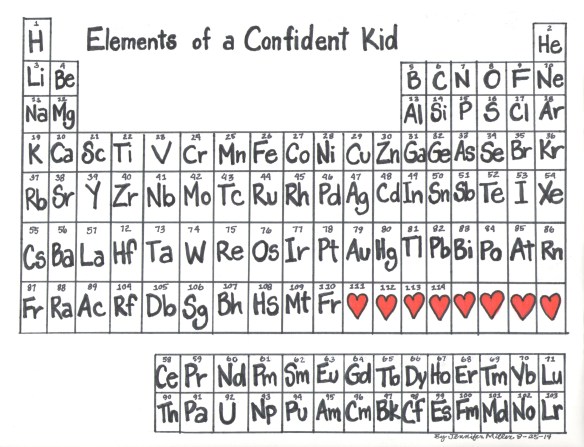
In addition to my weekly article containing research and strategies on promoting social and emotional skills in busy family life, I will be adding a weekly series entitled “Elements of a Confident Kid.” To date, researchers do not agree on a single definition of confidence but we certainly know what it looks like when we see it. I choose “confidence” for the cornerstone of this site since it encapsulates all of the attributes we want for our children as we prepare them for their independent lives and what we want for ourselves as we parent — mistakes, sure, but no regrets. Psychologists and other social scientists do widely agree on the components that make up a confident person. Each week, I will work on further defining what it means to raise a confident kid using the structure of the Periodic Table. Each entry will define one quality or attribute (“element”) of a confident kid and offer one strategy for promoting it in a family. I hope you will contribute to the dialogue by sharing what the elements mean in your home and ways you promote them. Check out the first one below. And thanks in advance for reading, sharing and contributing!

Sincerely yours,

Jennifer 2 signature 001


%22Humor%22 illustration

 hu mor

/hyu-mer/
: a funny or amusing quality
: jokes, funny stories, etc., or a particular kind
: the ability to be funny or to be amused by things that
are funny1

About Humor: Psychologists have for many years been trying to figure out what makes people laugh. The Humor Code2 published this past spring claims to have identified a theory called the benign violation theory to explain how humor works. The idea is that the joke breaks a convention from our expectations but still feels safe. And how does a person develop a sense of humor? Though we are still not certain, it’s likely a nature and nurture proposition. We are born with the DNA makeup to support a sense of humor and our environment gives us practice and reinforces that ability. It’s not surprising that families who value and use humor produce more humorous children.

Strategy to Promote Humor at Home: When was the last time your family laughed together? Can you quickly remember a time? How long ago was it? Yesterday? Last week? Last year? Thinking about what makes your family laugh and then looking for those opportunities is probably the best way you can promote humor. Sharing the experience together will offer modeling and practice. Games, joke books, singing karaoke and video taping ourselves are all ways our family laughs together. My son’s favorite joke is, “What do you say to the giant polar bear wearing headphones on his ears?”

Answer: “Anything you want. He can’t hear you.”

Why Promote Humor? Humor can offer individuals resilience in hard times. It can become a powerful coping strategy. Humor can also connect people to one another whether it’s a brand new friendship or a long-term relationship.

The Confident Kid Brand of Humor: Of course there are a few kinds of humor that do not promote a confident kid so it’s worth mentioning. Humor that is demeaning of others teaches children how to be hurtful through humor. Some children and adults use humor in this manner and it can be evidence of a lack of self-worth. In addition, sarcasm is a common form of humor that slips easily into everyday language. It’s often used to connect with others. But for children, sarcasm can teach dishonesty and breed mistrust. After all, children cannot discern sarcastic comments from literal ones but they feel the misleading nature of the comment. It can be confusing and difficult for children to understand. Confident parents and kids use humor that all can enjoy and does not harm others.


1. Merriam-Webster Dictionary Online. Retrieved from http://www.merriam-webster.com/dictionary/humor on 8-26-14.

2. McGraw, P., & Warner, J. (2014). The Humor Code: A Global Search for What Makes Things Funny. NY, NY: Simon & Schuster.

Reader Question and Answer about Games to Support Development

Let the Games Begin Illustration

One reader, Michele Rammien, wrote in with a great question that I thought would be helpful to many readers so am putting her question and my response into a post.

Michele wrote: I love these emails! They have been informative & helpful. I may have missed it somewhere but do you have suggestions of games to play with 5 & 6 year olds that relate to these development stages? Looking for something fun so my son does not think it is learning.

My Response: Thank you and I appreciate your great question! Yes, there are so many activities and games for five and six year olds that help with their developmental work and are disguised in fun. Here are some I use with my son:

Alphabet or Word Treasure Hunt:

Developmental Learning: letter or word recognition, love of surprises and puzzles, desire for mastery and getting there first

This game is a good indoor activity. Write each letter of the alphabet on single index cards, one per card. Tape a letter or word card to an object that begins with that letter. For example, the “P” card gets taped to the piano. Place the cards all over the house. You can make the placement of the cards easy or hard to find depending upon what kind of challenge you anticipate will be enjoyable for your child. Give your child a full alphabet as a reference throughout the game and also a gift bag to collect the cards. Now hunt! Each time your child finds a card, in order to “claim the prize,” (a.k.a. put it in his gift bag) he must name the letter (or word). If he cannot, no problem. Look and sing through his alphabet reference and find it together. My son loves this game and when he collects all of the cards, the first thing out of his mouth is “Let’s do it again!”

Twister:

Developmental Learning: balance, turn taking, learning left from right

Remember this game? Fives and sixes love this game. Throw the matt out on the floor. Have each player take turns with their moves versus all moving at once to get practice with turn taking. An adult will likely need to spin and provide support with left and right directions. Giggles always ensue. In fact, there’s a hot game going on outside my window as I write this post.

Pretend Play:

Developmental Learning: understanding rules, practicing manners, communication, assertiveness

Teddy Bear Tea Party:

Have your child set the table with your help for the party. When ready, invite his favorite stuffed animals to join you. Let your child lead the pretend play. Encourage him to teach his guests the rules of the party. Have him serve each of his guests and perhaps, suggest a toast or a speech.

Playing School:

Teacher Jr 001Again, let your child lead the play script. Help him get a school room set up with chairs and a chalkboard (even though classrooms don’t contain these anymore!), favorite books and other supplies. His students can be you, a sibling and his stuffed friends. Encourage him to teach the rules of the class first and then teach whatever he’d like.

 “If a Person Came to Visit…”:

Developmental Learning: perspective taking, empathy

This is a great one to play at mealtime or during a car ride. No supplies necessary. Players take turns throwing out names of familiar people – friends, family, neighbors or famous people. “If your kindergarten teacher came to dinner, what would she say?” “If Grammy came to dinner, what would she say?” Do a full circle go around and have each player pretend they are talking like “Grammy.” “Oh, this dinner is lovely, dear!”

For times when you are waiting in line or on a car ride, check out my article, “Waiting waiting games illust 001Games.”

For times when you have a group of kids, try out “Let the Games Begin!” for practicing cooperation and communication.

If you try out others, please send them to me so I can share! Thanks again for writing in and happy game playing!

A Time to Pause: Reflecting on Development in the Coming School Year

Growing boy with loose tooth

We are called to be strong companions and clear mirrors to one another, to seek those who reflect with compassion and a keen eye how we are doing, whether we seem centered or off course…we need the nourishing company of others to create the circle needed for growth, freedom and healing.

– Wayne Muller

After the teacher said a quick,”Goodbye parents!” with a kind but determined hand motion, I walked away from E’s classroom feeling a thud way down deep. “Now what?” So much preparation went into the start of school and now that he was successfully there, I felt a bit lost. It took that first full day of school for me to pull it together and begin getting my head around my own goals. Since there is a natural pause that occurs with the exodus of children to school, why not take advantage of that pause to do some reflection about your role, your child’s developmental milestones ahead and your hopes for the school year.

I take this moment of pause to ask:

What will my child be learning in the coming year academically, physically, socially and emotionally? What milestones are ahead?

What can I do to educate myself about his growth potential for the coming year?

What can I do to support that learning and growth?

It’s particularly helpful to set your own expectations for the learning to come since often times, our biggest challenges and frustrations with our children relate to where they are developmentally. “Don’t teach me anything!” said E this summer with passion as he tried to learn to swim. The process of learning can be embarassing, frustrating and sometimes painful. Our sensitivity to this fact can afford us greater empathy and patience. It can also prepare us to be better partners with teachers as we work to support our children’s growth.

Your school may have provided you with a set of academic learning standards for your child’s grade level so that you can get a sense of the areas of focus for the school year. If not, now you can check out the Common Core Standards since forty-three states, the District of Columbia and four territories have adopted them. But unless you are fortunate enough to live in one of the few states (Illinois, Kansas, Pennsylvania, and soon-to-be Ohio) that has adopted stand-alone learning standards for social and emotional learning, you may not receive any guidance in that area though your children’s social and emotional learning at school and home will continue.

Keep in mind that development is uneven. As I’m sure you’ve observed, it comes in fits and spurts. The traits listed below are derived from looking at a large number of children at a particular age with many to most showing they are working on these issues. If your child is not yet displaying these traits, there is typically no reason to worry. It’s likely they just may not have moved forward in that particular area yet. Of course, if you have concerns, contact your pediatrician for confirmation. I have a first grader, six nearly seven year old, so I am placing below the typical social and emotional traits for six and seven year olds. If you have children who are other ages, here are some resources for looking up their social and emotional developmental milestones for the year to come.

1. Yardsticks Parent Pamphlets – Chip Wood has created pamphlets for parents  that are easy to use and review. One set will grow with you as your children progress. The pamphlets list typical developmental milestones in physical, social-emotional, language, cognitive, vision, fine and gross motor skills and additional domains.

2. Child Development Institute – This site has a section specially for parents that offers guidance and many specific developmental issues.

3. education.com – This site offers a number of articles on children’s social and emotional development.

The social and emotional development traits of sixes and sevens are derived from multiple sources but the primary source is from Yardsticks; Children in the Classroom Ages 4-141 by Chip Wood. In addition, I’ve developed a list of ways that you as a parent can support those traits.

Typical Social and Emotional Developmental Traits for Sixes:

  • Anxious to succeed, even master whatever they are attempting.
  • Wants to be first.
  • Thrives on encouragement.
  • Loves surprises and treats.
  • May be easily upset when hurt.
  • May invent his own rules to games – winning is important to him.
  • Can be bossy and critical of others (as she works to define her own self-identity and boundaries).
  • Cares about friends.
  • Learns best through discovery and asking questions.
  • Is ambitious and motivated to learn.
  • Can engage in cooperative activities.
  • Enjoys “work,” particularly the process rather than product.
  • Feelings about his relationships with teachers and peers motivates his willingness to participate in school.

Ways to Support Sixes:

  • Compliment efforts and hard work versus final products.
  • Ask open-ended questions. Have patience and leave empty space for responses.
    Look for ways to allow child to be first (i.e. pressing the elevator button, ordering at a restaurant).
  • Ask about friends’ likes and dislikes.
  • Model empathy and perspective-taking to balance criticism of others.
  • Encourage practice and reinforcement of boundaries and rules.
  • Promote cooperative activities when playdates take place.
  • Take advantage of motivation to learn and explore new topics together.
  • Emphasize and provide examples (athletes, musicians) of mastery taking time, practice, failure and persistence.

Typical Social and Emotional Developmental Traits for Sevens:

  • Introspective.
  • Needs stability, routines and structure from adults – parents and teachers.
  • Attempts to make work perfect. May be more fearful of learning and feel pressure to achieve and not make mistakes.
  • Can be sensitive to others’ feelings.
  • Cares about organization of toys and supplies.
  • May change friends often.
  • Listens well and speaks using specifics.
  • Wants to finish what he begins and may go slowly.
  • Enjoys being read to.
  • Can be moody, sad or shy.
  • Enjoys challenging puzzles or small manipulatives (legos).

Ways to Support Sevens:

  • Provide more quiet time and space. Supply private journal or notebook for writing and drawing reflections or stories.
  • Go over morning, after school and bedtime routines. Formalize by having child put routines in writing. Be consistent.
  • Emphasize and provide examples (athletes, musicians) of mastery taking time, practice, failure and persistence.
  • Practice perspective taking. Discuss others’ feelings in the family to encourage empathetic thoughts and feelings.
  • Provide empty bins and receptacles to encourage self-organization.
  • Encourage friendships with playdates. When children move on from one friend to another, discuss ways to include and be kind to old friends as well as playing with new ones.
  • Listen to the details of stories told and ask pointed questions.
  • Give them extra time to do homework or perform a task.
  • Read together everyday.
  • Identify places and things in the house to offer comfort when he is upset.
  • Offer age appropriate challenges in play.

Setting your own expectations about a child’s development can help you be proactive about your support. You will be better able to face any challenge with knowledge and confidence. Here’s to a rich year of learning.

Do contribute to our ongoing parent dialogue. How are your children currently challenging you? How are you supporting their development?


Wood, C. (2007). Yardsticks (3rd. Edition): Children in the Classroom Ages 4-14. Turners Falls, MA: Northeast Foundation for Children.

What’s in a Name? Teaching Children the Art of Introductions

Introductions

The beginning of wisdom is to call things by their right names.

– Chinese Proverb

It’s been said that the sound of our own name can be magical. It’s often true and particularly so for a child. I remember the principal saying “Hello Jenny.” to me in the school hallway. And I was in awe. “The principal knows my name?!”, I thought. When your children are entering a new classroom and grade level, there will likely be at least a few new faces they will encounter as the school year begins. We, as adults, sometimes skip or simply forget introductions between children. Teachers may introduce themselves and miss out on the chance to introduce students to one another. For teachers in classrooms, staff of after school programs, coaches for sports teams or Moms and Dads picking up their children on the playground, ensuring that there are full rounds of introductions on multiple occasions is an essential step toward building a sense of connectedness and community. Our name is an important part of our self-identity. Learning names can be a doorway to building relationships. As long-time educator and author Roxann Kriete wrote “Naming is often the beginning of knowing.”1

However name recall can be a great challenge for adults as well as children. Researchers found that when introductory conversations take place, people typically remember jobs and hobbies before they will be able to remember names. Psychologist Jeremy Dean writes that it has everything to do with meaning.2 We are able to better understand people or define their personalities through job titles or activities. A name like Anna on its own provides no specific information about who she is. Although it’s comforting to know that it’s human nature to have difficulty recalling names, it does not lessen the importance of knowing and using names in our daily interactions.

You can certainly give your child an advantage when walking into new environments and trying to make friends by modeling and practicing introductions. This summer, I stood around with other parents dropping off my child at a new camp — with unfamiliar staff and children. After no introductions were made on day one, I started introducing my son to a few other children and myself to other parents. I witnessed a substantial difference in my son’s motivation and eagerness to engage with the other kids and participate in the camp after the introductions had been made.

In teaching any skill, the best educators break down what adults may consider “the basics” into smaller steps and teach children each of the component skills. Try out these next steps with your children and see if they feel more confident starting school in the next few weeks.

Explore why names are so important.

Read Harry and the Bucketful of Dinosaurs 3 to kick off a conversation about the importance of names. Or go through the pile of stuffed animals in your household with your child (if your house contains many like mine) and make sure that each has a meaningful name. Tell the story of how you came up with your child’s name. Why was it a special name for you? If you do not know the meaning or origin of your child’s name, look it up together.

Find a chance to practice an introduction and reflect on it.

Make it silly if you like. Introduce Dad to your daughter at dinner. Or introduce your favorite teddy bear to the rubber duck bath team. “Ted Bear meet Duckie.” “It’s so nice to meet you. I’ve already heard so much about your adventures together.” Reflect on what you did during the introduction. What did your body look like? Eye contact, leaning in and shaking a hand are all ways you can show you are interested in greeting another. What specifically did you say? “Hello, my name is Anna. What’s your name?” is an easy way to begin.

When making introductions, find out one thing about the other person.

Assist yourself and your child with recall by associating a person’s name with something meaningful about who they are. “What do you like to play at home?” or “What’s your favorite game?” might be standby questions for your child to ask to begin to get to know a person.

If you are playing host, facilitate learning each other’s names.

Playdates or birthday parties are times in which friends and family are brought together from a variety of contexts and may not know one another. Help establish connections by providing name tags. And before pinning the tail on the donkey, facilitate a name game to help children learn each other’s names. For ideas on a variety of name games, check out The Ultimate Camp Resource on Name Games.

And what if you forget a name? Help your child know what to do.

Those moments can be awkward when your child wants to interact with another but just cannot remember his or her name. What can he say? “Excuse me. Can you tell me your name again?” Practice and model this with adults when you have the chance so that he can watch how it’s done and be ready when he’s feeling uncomfortable.

And for educators and others who work with groups of children, remember it takes multiple exposures to a name to remember it. Name games such as those described in The Morning Meeting Book can be an enjoyable way to practice introductions, remember names and get to know each person in a classroom community. One of my favorites is the simple Adjective Greeting in which each individual picks an adjective that begins with the same letter of that person’s first name. You can call me “Joyous, Jovial and Jumpy Jennifer.”

Children who are able to recall and use others’ names demonstrate confidence and assertiveness. Using names imbues the greeter with the power to build relationships. However the ability to introduce oneself does not always begin naturally or comfortably. Equipping your child with the ability to introduce himself will prepare him for entrance into any social context. How do you practice introductions with your children?


1 Kriete, R. (2002). The Morning Meeting Book. Turners Falls, MA: Northeast Foundation for Children.

2 Davis, J. Why People’s Names Are So Hard to Remember. Retrieved on August 14, 2014.

3 Whybrow, I., & Reynolds, A. (1999). Harry and the Bucketful of Dinosaurs. New York: Random House.

Easing the Transition Back to School

Easing the Transition back to school

I’m gonna hold onto this couch and never let go!

– E. Miller, Age 6

It’s the morning after our summer vacation at the lake. E awoke and said he had had a nightmare. “My school became a haunted village. A ghost dragged me around the grounds. And all of my school friends were at my house playing with my favorite toys.” Though there are still a few weeks until the start of school, he is anticipating, not only the beginning but also the end of his freedom. And he worries about the unknown, faceless teacher who will rule over his days to come. Starting back to school can be an exciting time but as with any transition, it can also be fraught with worry, fear and a sense of loss. How can you best support your children as they go through this annual rite of passage?

Say goodbye to summer.
Summer days are so sweet and fleeting. Perhaps you spend precious family time laughing and enjoying one another in ways that may not occur as often during the hustle of the school year. As a family, find a way to say goodbye to summer. It could be as simple as an ice cream sundae indulgence or a campfire in the backyard. Pitch a tent or simply throw your beach blankets on the grass and stargaze. My husband proposed sharing a slideshow of seasonal photos with the grandparents. While you are savoring those last summer moments, take a moment to reflect on some of your happiest times over the last few months. When did you laugh the most? What were your favorite moments on your travels or local adventures? What animals or plants did you encounter? What activities do you want to repeat next summer?

Create rituals for the ending and beginning.
After finding a way to reflect and enjoy summer’s end together, how will you anticipate all that is positive about starting the school year? In addition to new tools including the fresh smell of a new box of crayons and razor sharp Ticonderoga twos, there are friends with whom to reconnect or perhaps new friends to be made. Haul out a few projects from last year and display them once again to remind your child of the success she has already experienced in school. Make a ritual out of getting school supplies by buying them together and then enjoying a special meal together or engaging in your child’s favorite activity as a family.

Create or recreate your routine.
Part of the annual preparations in our house for the school year is the creation of the morning routine poster. Going over your morning routine can offer great comfort to a child who has not gotten up at the crack of dawn or needed to get dressed and move quickly for months. Don’t expect that they will snap back into the routine easily. Pave the way by discussing how your morning will progress together. Find out what your children’s expectations and hopes are. Writing down your child’s routine formalizes it and helps provide a reminder to return to if there are struggles in those early days of school. Check out “A Truly Good Morning” for more ideas about creating a smooth morning routine for your family.

Practice!
Does your child walk to school? Do they take the bus? Offer a practice dry run opportunity to add a feeling of comfort and safety before the first day. Get up at school time. Get dressed and follow your route to school whether it’s walking or driving. If your children take the bus, go to their bus stop and then drive the route to school. Talk about where they might want to sit and how they could introduce themselves to other kids and the bus driver. When you arrive at the empty school yard, walk around and show your child where they will line up or meet their teacher. Then go to your favorite coffee shop or donut house and get a morning snack to add a sense of celebration. Though this practice may seem like an extra step, it will pay off when you witness your child entering the school year with more confidence.

Involve children in preparations.
Work on a calendar for your child’s room and place all of the major events in the school year on it including friends’ birthdays and days off. Engage your child in placing their name in notebooks, on pencil holders and other school tools. Prepare your child’s homework space. Talk about what tools they might need at home and get them organized and ready. Perhaps work together on making a pencil holder (using a well rinsed frozen juice can, paper, glue, stickers and markers) or decorating book covers. Create a binder for papers sent home. Parents often fall into the flurry of preparations and may just check items off the list. Think about how you can involve your child knowing that this will pave the way for them in thinking about the tools and organization they need in order to be successful this school year.

Listen.
Show that you are open and willing to listen during this time of transition. Children will be more likely to share their worries. Perhaps begin a conversation with him about his experience with his last teacher and how he got to know her and like her. Ask questions about rich memories from last school year and offer the space for your child to tell you about his school experiences. If worries emerge in conversation, you, in turn, can address those through practice, involvement and reflection.

Show additional sensitivity.
Children will have heightened emotions during this transition from summer to the first months of the school year. They are adjusting to major changes in their life including new faces and new expectations. Be aware that greater upset about minor issues may indicate anxiety just below the surface. If children are unable to identify or articulate their feelings, offer feeling words and ask if they are accurate: “It sounds like you are worried. Are you worried about having a new teacher or being in a new building?”

For more ideas, check out “Back to School Butterfiles.” And if your child is moving from preschool to kindergarten, do check out the article, “In Between Here and There.” 

Taking steps to prepare your children through rituals, celebrations, organization, reflection and showing empathy for their situation can contribute to a sense of safety and security in the midst of change. Not only will it help create smooth transitions during each day for your family, but it will also allow your children to enter the school year with an open mind and heart to experience the joy and possibility of learning.

Interview on Feeding My Family

Jennifer Miller Interviewed by Table 365
Jennifer Miller interviewed by Table 365. Photograph by Kimberly Allison.

Author and Illustrator of Confident Parents, Confident Kids, Jennifer Miller was interviewed this week by Kimberly Allison and Sharon Perez of Table 365. They asked questions on how I feed my family. Their mission is to provide inspiration, ideas and tools to make family meals easier. I’ve been inspired by their site. Check out the interview and then check out the rest of the site for true inspiration for family meals! Thanks Table 365!


Happy Father’s Day!

Dad and Jenny at the beach

Any man can be a father, but it takes someone special to be a dad.

— Anne Geddes

Here’s to all of the Dads who embrace their roles and are there for the fun times and the hard times too when we need them most. I am grateful to my own Dad who has always been there for me and to my husband who is always there for our son. Thanks, Dads!

Lazy Days of Summer

by Jennifer Miller

Deep summer is when laziness finds respectability.

– Sam Keen

As school ends and summer begins, we are sitting outside and dreaming of the many delights the season brings. We have big plans to read, swim, blow bubbles, build sandcastles, catch fireflies and sit and watch the clouds. Last year, I put together a summer reading list of favorite parenting books. This year, I am highlighting the top five all time favorite, most-read posts for your summer reading. See if they may bring you new or renewed insights. Confident Parents, Confident Kids is taking a vacation to play, to be and to live in the spirit of the warm sun. Rest assured, the posts will return in August with the start of the school year. Meanwhile, my wish for you is for lazy summer days.

Confident Parents, Confident Kids Top Five Posts:

1. Parent-Teacher Conversations

Teachers gain plenty of experience over time having difficult conversations about students with parents. However if you are parent, you may only experience difficult conversations with teachers a few times in your children’s educational careers. It’s conceivable that your child may come home with issues or concerns that merit your initiation of a conversation with a teacher. With only your child’s words to inform you, you need more information and parent teacher convos 3 001the help of her teacher to really understand the problem. “Will I sound like I am accusing the teacher or another student or parent?” “Will the teacher penalize my daughter or like her less because of our conversation?” and “Will my discussion with the teacher lead to tensions between our family and that teacher and possibly other teachers in the future?” These are all valid questions that are raised in the minds of parents before they proceed with a conversation. Read more…

2. Cultivating a Sense of Competence

At all ages and stages, kids admire and desire competence. Particularly as they enter the Thinking about Competence illustr 001middle school years, 10-14, figuring out what they can do and what their interests are establishes the basis for their social and academic life. It can define a friend group and sometimes seals the perception of who a student is with his teachers. Is he a straight “A” student? Does she excel at electronics? Is he a soccer player? My husband claims that competence in music in high school band was primarily responsible for pulling him out of the shyness of his middle school years. Read more…

3. The Power of Self-Control

In the hero’s journey, an ordinary person is called through extraordinary circumstances to sacrifice a part of him or herself in order to serve the greater good. In doing so, the reward or victory is self-knowledge and a demonstration of character that the hero must then use in the world from which he or she came.[i] To be a Jedi Knight in the classic story Star self control illustr 2 001Wars, the means through which Luke Skywalker defeated the darkness was by learning self-discipline. Yoda teaches, “To answer power with power, the Jedi way this is not. In this war, a danger there is, of losing who we are.”[ii] The modern day hero in all of us must defeat the dark forces of fear, ignorance, greed and ego. Listening to and following our truth when faced with difficult decisions requires practice and repeated trials. Temptation to stray from the hero’s path is part of the initiation. The hero typically fails in his attempts numerous times but persists in striving toward greater self-control and self-knowledge. Read more…

4. Expanding the Circle: Teaching Children Inclusion

All children have to deal with and understand the paradox of separateness and connection, of individuality and belonging. In utero, babies have no sense of separation. They are physically connected to Mom through the very liquid they breathe and the cord Expanding the Circle 2 001through which they receive their food. For most children, the birth process will be the biggest stress of their young lives. They discover that they are separate beings but need their attachment to their parents in order to survive. Do you remember in the first few months of your child’s life when he was fascinated with his hands? He was grappling with his individuality and separation. Then, when children enter their first playgroups or preschool, we encourage them to share, to cooperate and to take turns with other children. They have spent most of their time as infants and toddlers figuring out their individuality only to find that they are supposed to connect to others and that there are rules (sometimes confusing since they change in various environments) that govern that involvement. Read more…

5. The Fear of Failure

It may be that the most important mastery we achieve early on is not the mastery of a particular skill or particular piece of knowledge, but rather the mastery of the patience and persistence that learning requires, along with the ability to expect and accept mistakes and the feelings of disappointment they may bring.

– Fred Rogers in Life’s Journeys According to Fred Rogers

“Mama, I didn’t have such a good day yesterday,” E says as he puts on his clothes to Fear of failure illustration 001prepare for another day of school. “I cut out the tree when I should have colored it first.” Now with tears welling up in his eyes, he continues, “And I laughed while I was waiting in line and the teacher said the next time I did it, he would send a note home to you. Will you be really mad if he sends a note home?” Read more…


Say What?

Listening Illustr JSM

When you really listen to another person from their point of view, and reflect back to them that understanding, it’s like giving them emotional oxygen.

– Stephen Covey

Most parents, particularly with young children, may feel like they are listening all day long. Because children are exploring the world around them, they may have many observations and questions. “Why are you going upstairs?” “What is Dad doing now?” “How many days until school is out?” and “Why is that bird chirping outside our window?” Though we perceive that we are listening regularly, often times, the reality is, we are not. Research reinforces that notion. The average person listens with only 25% efficiency.1 And no wonder. There are multiple distractions from people and media that compete for our attention. Listening is a critical skill for your children as they attempt to make friends, participate in family life and achieve in school. When your child does not listen to you, it can be extremely frustrating and sometimes dangerous if for example, you are warning them about a safety issue. Effective listening in which the person hears and understands what is said, can build trust in a relationship, reduce conflict and inspire a higher level of commitment to working together.

As you prepare for school letting out and having your children home more of the time, why not practice some listening skills to proactively promote stronger communications? Try out the following practices.

Have a dinner conversation about listening.
You might pose the question, “What does it take to listen well?” “What do our bodies do when we listen?” Start a conversation with the whole family and allow each member to contribute. Model listening by allowing each person to complete their thoughts without interaction or judgment.

Practice listening strategies.
Try interactive modeling with listening skills. Model the listening technique and then, ask your child to try it out.

  • Active Listening is listening to fully understand what the person is saying. Wait until the person is clearly finished. A response is a simple “yes,” “uh-huh,” or “I get it.” Make eye contact and practice placing your full focus on the speaker.
  • Providing Wait Time is particularly important with children but can also be important with adults. We get anxious with our own needs and thoughts and jump in before the speaker can complete their thought. Building from last week’s article, “The Chance to Wait,” providing wait time can allow for deeper thinking and better responses particularly when you ask questions of others. Wait for their response. What you may perceive as awkward silence may actually provide the space for the speaker to formulate her thoughts and come back to you with a well considered response.
  • Paraphrasing is echoing back to the person a summary of what they’ve said to check how accurate your listening is and also to confirm to the speaker that you have heard them. It may seem awkward at first. But this step is an important way to teach children how to listen for comprehension. It forces the listener to step up their game as they are going to be “on the spot” to communicate back what you have said. It might go something like this:

Parent: “I ran into my Kindergarten teacher at the grocery store today while I was getting you carrots and she said she remembered me.”

Parent Modeling Paraphrasing: “So you ran into your Kindergarten teacher and she remembered you.

  • Seeking Clarification is something that we, as adults, may do naturally. Particularly if we are listening with the intent to learn something from the speaker, we seek clarification on details so that we are certain we understand. Practice seeking clarification with your child and reinforce when they are able to do it on their own.

Mom to Dad: “What did you mean when you said you weren’t happy this morning. What happened?”

  • Questioning or Commenting with Empathy takes practice. Instead of responding to a speaker with your own opinions or experiences, you focus solely on the content of what has been communicated. Avoid using “I” in your response.

Child: “Today Mrs. Smith started a project with us. We are going to be building fairy tree houses. I can’t wait. I need to get sticks and lots of other stuff to help build it. Okay?”

Parent: You might be tempted to say, “I built a bird house when I was in school.” Instead you might say, “Okay. Sounds like you are excited about this project your teacher began. What else besides sticks do we need to collect?”

This pattern of speaking and listening may come naturally to some but to children, it is a major challenge and requires experience. Your modeling will make a difference in their own comfort with this style of communication.

Try out some listening games.

For Younger Children:
Telephone
This classic children’s game is not only fun but also instructive. Play this as a family or when a group of children are at the house for a playdate. Get the children in a circle. Whisper in the first child’s ear one sentence that they must whisper in the next child’s ear. The sentence get passed from child to child in a whisper. The final child gets to reveal aloud what he heard. Make the first sentence simple and increase the difficulty with each turn. Giggles are likely to result! A simple one may be, “The cat is orange.” A more difficult one may be, “The curious cat calls out his command to come.” On the first go-round, just pass the sentence. On the second go-round, ask, “what could you do if you didn’t really hear what was said?” This will give children additional practice in seeking clarification. You could model what they might say. “Could you repeat that, please?”

For Older Children:
Robbery Report
If you have children 9 and up, this will be a true challenge for them. Created by Classroom Conflict Resolution Training for Elementary Schools in San Francisco, California and reprinted in the A Year of Student’s Creative Response to Conflict curriculum, it has been used effectively in classrooms. Children love it! The parent relays a robbery report and children must remember the details of the report by listening to it. Say it once and see what they can remember. Then, read it a second and perhaps, third time and see if they’re listening improves.

Parent: “Please listen carefully as I have to go to the hospital right away. I just called the police from the gas station on the corner. Wait here and report the robbery to them. I was walking into Johnson’s Convenience Store and this guy came running out and almost knocked me over. He was carrying a white bag and it looked like he had a gun in his left hand. He was wearing a Levi jacket with the sleeves cut out and a green and blue plaid shirt and blue jeans with a hole in the right knee. He had skinny legs and a big stomach. He wore wire rim glasses and high top red Converse tennis shoes. He was bald and had a brown mustache and was six and a half feet tall, probably in his mid-thirties.” 2

Adult Listening Challenge
In addition to modeling and teaching your child skills in listening, here’s a challenge for you to exercise your own listening skills. This is not easy! It takes concentration. Try it out multiple times and see if you can make improvements as you practice.

Listening for Thought, Listening for Feeling
Pick any listening opportunity in a day whether it’s listening to your child relay a story from school or your partner telling you about his day at work. In addition to listening to the content of what the person says, also see if you can identify the unspoken thought and feeling behind the content, in other words, the context. Here’s an example.

Your Partner: “Oh, the day was okay. I had four meetings back to back this morning and they seemed to drag. I am glad I checked them off the list.”

Thought: The morning was long and difficult.

Feeling: I was tired and bored and am now feeling relieved that my meetings are over.

Now that you have identified the thought and the feeling, you can better respond to your partner. Listening is a skill that can bring a family closer together if practiced regularly. Try out one of the techniques or games and see if adds a sense of connection and understanding to your family communications.

References

1 Williams, S. Listen Effectively. LeaderLetter. Dayton, OH: Wright State University Raj Soin College of Business. Retrieved on 5-20-14.

2 Nia-Azariah, K., Kern-Crotty, F., & Gomer Bangel, L. (1992). A Year of Students Response to Conflict: 35 Experiential Workshops for the Classroom. Cincinnati, OH: Center for Peace Education.